New Change Gardens

195k
80%
100%
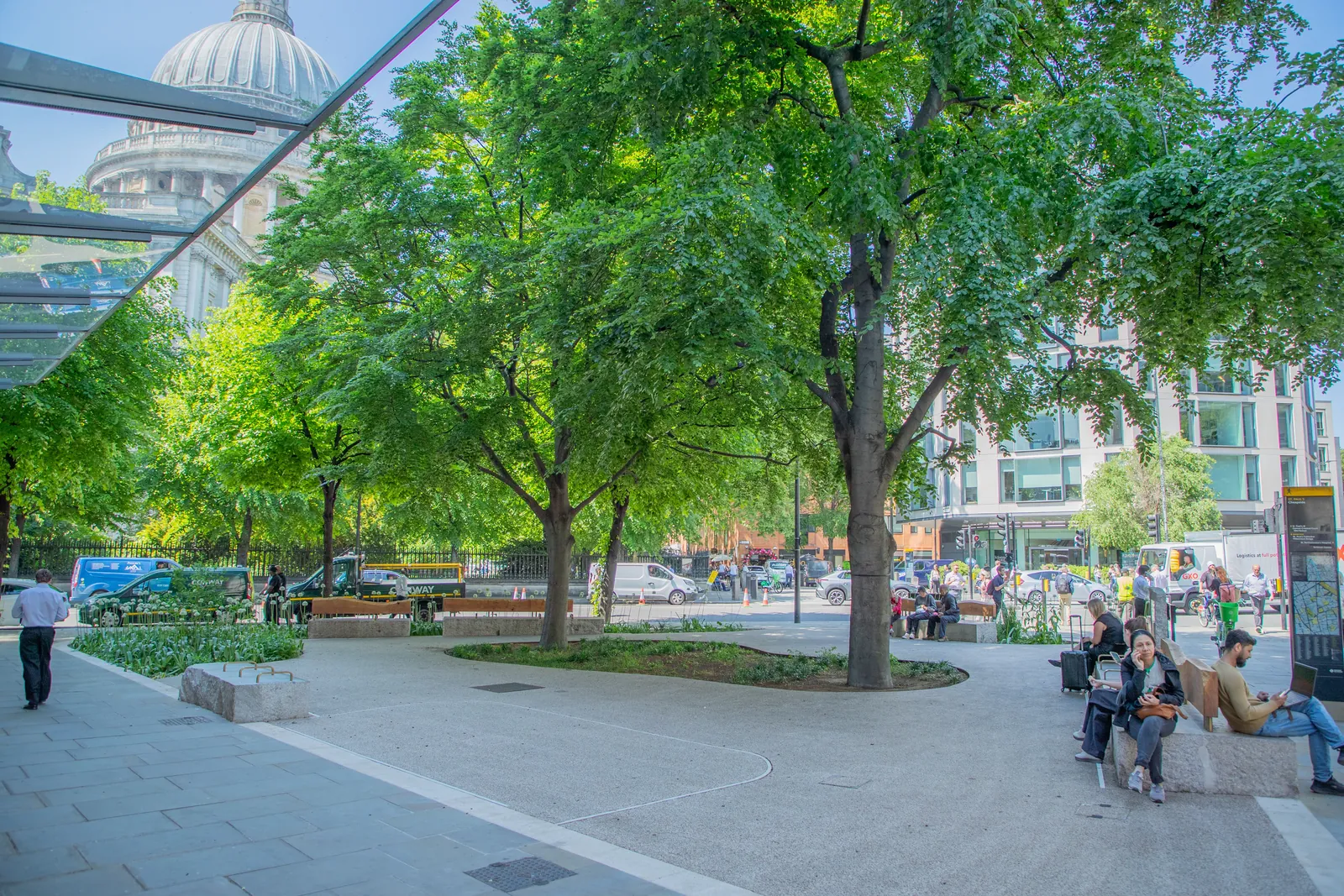
New Change Gardens sits at the junction of Cheapside and New Change, in the shadow of St Paul’s Cathedral. It was hard-edged, inaccessible, and cut off from the people around it. The City of London Corporation wanted to change that as part of their wider Greening Cheapside initiative. Our team supported the drainage and levels strategy that made it possible, removing 195,000 litres from the combined sewer annually, restoring step-free access from all directions, and reusing heritage materials throughout.
The drainage strategy fundamentally reoriented how the site manages surface water. By replacing impermeable paving with permeable resin-bound surfacing, the primary disposal mechanism was flipped from sewer discharge to infiltration. The catchment is now disconnected from the combined sewer network entirely. 195,000 litres no longer enter the sewer annually. The surfacing also removes 80% of silt, heavy metals, and hydrocarbons before they reach the sub-soil, a meaningful improvement in pollution prevention and water quality.
The permeable surfacing also resolves a constraint the previous design couldn’t address: the root systems of the two 60-year-old Beech trees on site. Hard impermeable paving starved the roots of water and oxygen. The new surface allows passive irrigation and improves long-term growing conditions without the risk of drowning the historic trees.
Levels, access, and climate resilience
The external levels strategy was coordinated across the full garden footprint, balancing drainage falls, accessibility requirements, and the root protection zones of the mature trees. Step-free access is now achievable from all approaches.
Climate resilience was embedded beyond drainage. Working closely with the landscape architects, our team supported the selection of a climate-adapted planting palette capable of withstanding increasing urban heat and drought. The vegetation buffers traffic noise from the surrounding streetscape, intercepts airborne pollution from Cheapside, and provides meaningful co-benefits for the workers and visitors who use the space daily.
Circular economy in practice
The seating uses reclaimed granite from Joseph Bazalgette’s 1875 Thames Embankment wall, recovered from another City of London project and given a second life here. No new stone extraction. No foundations required. The bench backs were made from London Plane timber salvaged from fallen street trees. Both decisions reduced embodied carbon and gave the space a material character connected to its city. The completed garden works as hard beneath the surface as it looks above it. It manages water, supports biodiversity, reduces heat and pollution, and is accessible to everyone who passes it. It is part of the City of London’s Climate Action Strategy and a proof point for what small urban spaces can do when they are designed with intent rather than treated as leftover land.